



SaaS Analytics Tools help teams see what is growing, what is leaking, and where users convert, so leaders can make faster, calmer decisions with clearer revenue visibility.
SaaS Analytics Tools are not just dashboards; they are decision systems that reveal how users move, where they drop, and which product actions predict long-term growth. For founders, marketers, product managers, and customer success teams, SaaS Analytics Tools turn raw behavior into practical insight. When the right signals are visible, growth becomes less about guessing and more about improving the user journey with confidence.
Modern buyers expect simple experiences, transparent value, and fast support. SaaS Analytics Tools make it possible to track those expectations across acquisition, activation, retention, expansion, and advocacy. That matters because each stage affects the next. A company can have strong traffic yet weak activation, or great product usage but poor renewal rates. SaaS Analytics Tools help uncover that gap early.
The best teams do not use analytics to admire charts. They use SaaS Analytics Tools to answer hard questions: Which channel produces the highest-quality users? Which feature drives retention? Which customer segment is most likely to upgrade? Which friction point is slowing trial-to-paid conversion? With the answers, growth plans become sharper and budget decisions become safer.
This guide explains how SaaS Analytics Tools support growth metrics, how to choose the right platform, which KPIs matter most, and how to use analytics without turning reporting into a burden. It also shows how related systems such as reporting systems and operational dashboards fit into a larger revenue strategy.
Why Growth Metrics Matter in SaaS
SaaS is built on recurring revenue, so growth is not measured only by new signups. The real story lives in how users adopt, return, expand, and renew over time. SaaS Analytics Tools help teams understand that recurring pattern instead of focusing only on surface-level activity. A dashboard that shows traffic spikes is useful, but a dashboard that explains retention behavior is far more powerful.
Growth metrics are the language of progress. Acquisition metrics show whether the market is discovering the product. Activation metrics show whether users experience value quickly. Retention metrics reveal whether that value lasts. Expansion metrics show whether customers deepen their relationship with the product. When SaaS Analytics Tools connect these layers, leaders can see how one stage affects another.
Many teams collect data without a clear decision framework. They know signups, sessions, and clicks, but they do not know which numbers matter for growth. SaaS Analytics Tools solve that problem by bringing structure to measurement. They help teams focus on metrics that align with business objectives instead of vanity numbers that look impressive but do not move revenue.
A good analytics strategy also improves accountability. When every department uses the same definitions, there is less debate and more action. SaaS Analytics Tools create a shared view of reality, which helps marketing, product, and customer success collaborate around the same growth goals. That alignment is especially useful when teams are also managing SaaS Stack And Security Mastery, since secure operations and clear data governance often influence how metrics are trusted internally.
Core SaaS Metrics Every Team Should Track
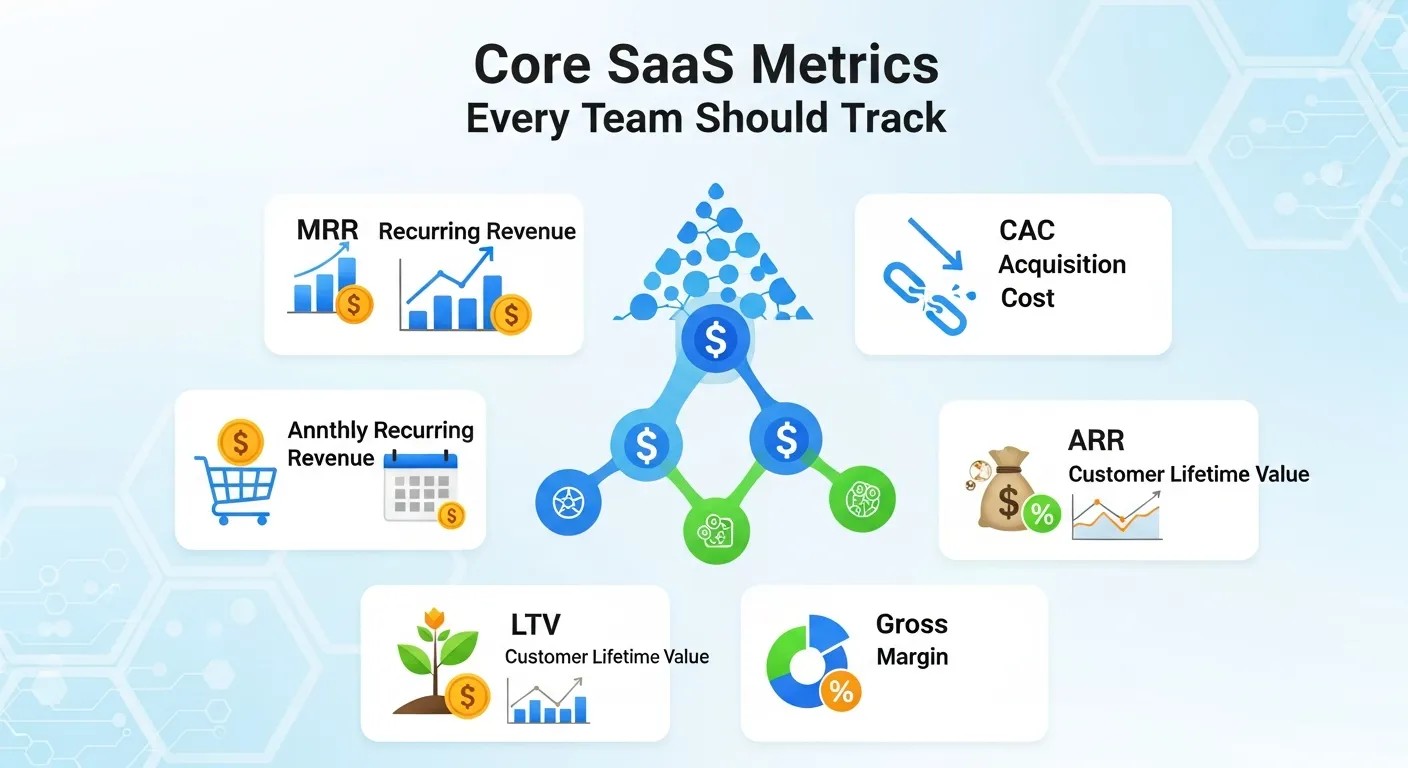
SaaS Analytics Tools are most valuable when they track the full customer lifecycle. The most important metrics are not the ones that produce the largest numbers; they are the ones that explain user movement and future revenue. To measure growth properly, teams should pay attention to acquisition, activation, retention, monetization, and advocacy.
Acquisition metrics
Acquisition metrics show how people arrive. These often include traffic sources, campaign conversions, demo requests, and trial signups. SaaS Analytics Tools help teams compare channel quality, not just volume. A channel that produces fewer signups may still be more profitable if those users activate faster and retain better.
Activation metrics
Activation is the moment a user first experiences meaningful value. That moment differs by product, but it always matters. SaaS Analytics Tools can track onboarding completion, first key action, setup progress, and time-to-value. If activation is weak, more top-of-funnel traffic usually will not fix the problem.
Retention metrics
Retention reveals whether users keep coming back. Churn, logo retention, cohort retention, and feature return rates all matter. SaaS Analytics Tools make retention visible by cohort so teams can see whether changes improve behavior over time. Retention is often the clearest indicator of product-market fit.
Revenue metrics
Revenue metrics show whether usage translates into financial growth. Monthly recurring revenue, annual recurring revenue, average revenue per account, expansion MRR, and gross retention are central signals. SaaS Analytics Tools help teams link product engagement to revenue outcomes so the business can understand which behaviors are worth encouraging.
Advocacy metrics
Advocacy often gets ignored, but it is a major growth engine. Reviews, referrals, case study participation, and social sharing can all signal customer confidence. Since Online Reputation Management influences trust and buying intent, SaaS Analytics Tools should also help teams understand how satisfied users shape public perception.
How Analytics Supports Decision-Making
SaaS Analytics Tools turn uncertainty into structured choices. Instead of asking whether a campaign feels successful, teams can ask whether it produced sticky users, efficient payback, and durable revenue. That shift matters because growth decisions often fail when they rely on opinion rather than evidence.
For marketing teams, SaaS Analytics Tools clarify which campaigns generate the most valuable users. For product teams, they show which features drive engagement and retention. For customer success teams, they highlight risk signals before churn happens. For executives, they create a simple story about what is working, what is not, and where to invest next.
One of the biggest advantages of SaaS Analytics Tools is pattern recognition. A single metric may look fine in isolation, but trends across time reveal the real story. For example, a trial signup spike that does not improve activation may indicate a messaging mismatch. A retention increase after a product update may reveal a feature that deserves more visibility. Analytics is useful because it connects behavior to outcomes, not because it produces more numbers.
The strongest teams use SaaS Analytics Tools with a feedback loop. They observe, form a hypothesis, test a change, and measure the result. That process reduces guesswork and creates steady improvement. It also helps leaders avoid chasing random wins that look exciting but do not last.
Choosing the Right Analytics Platform
Not every platform labeled as analytics is equally useful. Some tools excel at event tracking, others at revenue reporting, and others at executive dashboards. SaaS Analytics Tools should fit the company’s maturity, data stack, and decision-making style. A startup may need simplicity and speed. A scaling company may need segmentation, attribution, and strong integrations. An enterprise may need governance, permissions, and consistent data definitions.
When evaluating SaaS Analytics Tools, the first question is whether the system tracks the behaviors that truly matter. If a product depends on onboarding milestones, the platform must track those steps cleanly. If revenue depends on team-level adoption, the platform must support account-based analysis. If the business sells globally, it should handle region, currency, and segment differences without confusing the team.
The second question is how easily the data can be trusted. A beautiful dashboard is not helpful if the definitions are inconsistent. SaaS Analytics Tools should make it easy to standardize events, labels, and metrics. They should also support validation so teams can confirm that data is flowing correctly before making decisions from it.
The third question is whether the platform helps people act. A tool can store data without changing behavior. The best SaaS Analytics Tools promote clarity, not clutter. They guide teams toward the few numbers that matter most, while still allowing deeper analysis when needed. This balance is also important when the company uses SaaS Monitoring Tools, because operational health data and product growth data should complement each other rather than live in separate silos.
Must-Have Features in Analytics Platforms
The best SaaS Analytics Tools combine visibility, flexibility, and speed. They should not force teams into rigid reporting habits, but they also should not be so open-ended that every report becomes a custom project.
Event tracking
Event tracking is the foundation. SaaS Analytics Tools must capture user actions accurately across web, app, and product surfaces. Without reliable events, every downstream analysis becomes weaker.
Cohort analysis
Cohort analysis helps teams compare users who joined at different times. SaaS Analytics Tools with cohort views make it easier to see whether product changes improve retention or merely shift short-term activity.
Segmentation
Not every customer behaves the same. SaaS Analytics Tools should allow segmentation by plan, company size, industry, channel, geography, and usage pattern. Segmentation makes insights more actionable.
Funnel reporting
Funnels reveal where users drop off. SaaS Analytics Tools with clear funnel reporting help teams identify friction in onboarding, checkout, or renewal journeys. Small fixes in the funnel often create meaningful growth.
Revenue attribution
Revenue attribution is especially useful for teams that want to connect marketing activity to pipeline and closed-won deals. SaaS Analytics Tools should support attribution carefully so leaders can avoid false certainty.
Dashboard sharing
Dashboards should be easy to share with leadership and cross-functional teams. SaaS Analytics Tools with role-based access make it simpler to keep everyone aligned while protecting sensitive information.
Using Analytics Across the Customer Lifecycle

Analytics platforms become more powerful when they map to the customer lifecycle. Growth is not one event; it is a sequence of small wins that compound over time. Each stage needs a different lens.
At the acquisition stage, SaaS Analytics Tools should help teams understand which channels attract the right users. A large audience is not necessarily a qualified audience. A smaller audience with stronger product intent can outperform a broader campaign. Measuring quality early prevents wasted spend later.
At the activation stage, the platform should reveal how quickly new users reach value. If people sign up but fail to complete key onboarding steps, the problem may be in the product flow, the messaging, or the use case targeting. SaaS Analytics Tools can surface those weak spots quickly enough for the team to intervene.
At the retention stage, the goal is to understand habit formation. Users remain when the product becomes part of their workflow. SaaS Analytics Tools should show which behaviors correlate with repeated use, stronger renewal rates, and higher satisfaction. That insight helps product teams prioritize features that create stickiness rather than cosmetic engagement.
At the expansion stage, SaaS Analytics Tools should identify upgrade signals. Additional seats, higher usage, new modules, and cross-sell interest often follow clear behavioral patterns. Teams that see those patterns early can build better customer success motions and more effective upsell campaigns.
At the advocacy stage, the focus shifts to trust. Reviews, referrals, testimonials, and case studies are often downstream of strong outcomes. SaaS Analytics Tools can help teams see which customers are happiest, which segments are most vocal, and where social proof is most likely to appear.
Why Reporting and Monitoring Still Matter
Some teams think analytics, monitoring, and reporting are interchangeable. They are related, but they are not the same. SaaS Analytics Tools focus on understanding behavior and growth. SaaS Reporting Tools organize that information for ongoing communication. Monitoring tools watch for operational issues and performance changes in real time.
That distinction matters because a growth team needs both context and control. SaaS Analytics Tools help interpret what changed and why. Reporting tools help share those findings in a consistent format. Monitoring tools help detect problems before they damage the customer experience. Together, they create a more resilient decision system.
For example, a product team may notice that a feature is used less often after a release. SaaS Analytics Tools can help determine whether adoption dropped because of a UX issue, a channel shift, or a segment change. Monitoring tools may reveal whether the feature is loading slowly or failing for certain users. Reporting tools then package the insight for leadership review. That combination helps teams move faster without losing accuracy.
Common Setup Mistakes to Avoid
Even strong SaaS Analytics Tools can produce weak results if the setup is poor. One common mistake is tracking too many events without a clear decision purpose. Teams often assume more data means better insight, but irrelevant data creates noise. Better to track fewer actions well than everything badly.
Another mistake is failing to define metrics consistently. If one team measures activation as signup completion and another measures it as first login, the business will argue about the numbers instead of improving them. SaaS Analytics Tools should be supported by a shared metric dictionary so every team speaks the same language.
A third mistake is ignoring account-level context. In B2B, one user’s behavior rarely tells the whole story. SaaS Analytics Tools should connect user actions to accounts, teams, and revenue outcomes. Without that layer, it becomes hard to understand true product adoption.
A fourth mistake is treating analytics as a one-time project. Data systems change, products evolve, and customer behavior shifts. SaaS Analytics Tools need ongoing review, not occasional attention. This is especially true when teams manage SaaS License Management Tool workflows, because license usage and entitlement data often influence both adoption analysis and revenue forecasting.
How to Turn Data Into Growth Strategy
SaaS Analytics Tools are valuable only when the team uses them to make real decisions. The goal is not to collect more dashboards. The goal is to improve strategy, reduce friction, and grow efficiently.
Start with one business question at a time. Instead of asking everything, ask what blocks conversion, what predicts retention, or what increases expansion. Then configure SaaS Analytics Tools to answer that question clearly. Once the answer appears, test a specific change. Growth improves when analytics leads to action, not just observation.
The most useful teams create a rhythm. Weekly reviews can focus on leading indicators like activation and product usage. Monthly reviews can focus on retention, revenue, and segmentation trends. Quarterly reviews can focus on broader strategic shifts. These analytics platforms make this rhythm possible because they reveal change at different time horizons.
Another important habit is connecting analytics with customer feedback. Numbers tell you what happened. Customers explain why. When those insights are combined, teams can make decisions that are both data-driven and human-aware. That balance improves product quality, messaging, onboarding, and support.
For organizations using technical automation, SaaS Analytics Tools should also align with marketing systems and lifecycle logic. A misconfigured field or broken sync can distort the story. In some organizations, Adobe Marketo CRM Sync Issues can create gaps between lead behavior and revenue reporting, so analytics teams should verify data flow before drawing conclusions. Likewise, teams that use Global Marketo Tokens need to confirm that naming conventions and dynamic content logic are not creating inconsistent campaign reporting.
Building a Growth-Friendly Analytics Culture

Tools alone do not create insight. Culture does. SaaS Analytics Tools work best when teams trust data, ask sharper questions, and value measurable improvement over guesswork. That kind of culture starts with leadership. If executives use metrics only for blame, teams will hide problems. If leaders use metrics for learning, teams will surface issues early.
A strong analytics culture also values simplicity. Too many dashboards can overwhelm people and reduce action. SaaS Analytics Tools should make the important obvious. Leaders should ask for fewer metrics, clearer definitions, and better narratives. A good dashboard is not one with the most charts; it is one that helps people decide what to do next.
Cross-functional ownership matters too. Marketing, product, success, and finance should not maintain separate truths. When everyone uses the same SaaS Analytics Tools and agrees on core definitions, meetings become more productive. People spend less time debating numbers and more time improving outcomes.
Practical Metric Framework for SaaS Teams
A simple framework can keep analytics focused. Start with acquisition quality, then activation efficiency, then retention strength, then expansion potential. SaaS Analytics Tools should help teams measure each layer in a way that connects to revenue.
A practical scorecard might include visitor-to-signup conversion, signup-to-activation conversion, activation-to-retention conversion, retention-to-expansion conversion, and expansion-to-advocacy conversion. This chain helps teams see where value leaks out of the system. If one stage is weak, the next stage cannot fully compensate.
This is also where segmentation becomes essential. SaaS Analytics Tools should show whether different audience types behave differently. A segment that converts quickly may have lower support needs. Another segment may expand faster after onboarding. The more the team understands those patterns, the better it can allocate budget, product effort, and customer success time.
Conclusion
SaaS growth becomes much easier to manage when teams treat data as a guide rather than a report card. SaaS Analytics Tools help companies see how users move, where they struggle, and which behaviors lead to durable revenue. That visibility improves marketing, product design, customer success, and executive planning. The strongest results come when teams choose the right metrics, define them clearly, and review them consistently. With the right setup, SaaS Analytics Tools do more than measure growth. They help create it.
Frequently asked Questions (FAQ)
What are SaaS Analytics Tools?
SaaS Analytics Tools are platforms that track product behavior, customer journeys, retention, and revenue signals so teams can understand how growth is happening and where it is slowing down.
Why are SaaS Analytics Tools important for growth?
SaaS Analytics Tools matter because they show which actions lead to activation, retention, and expansion. That helps teams improve the customer journey instead of relying on assumptions.
What metrics should SaaS companies track first?
Start with acquisition, activation, retention, and revenue. SaaS Analytics Tools should make it easy to see how users move through the lifecycle and where they drop off.
How do SaaS Analytics Tools help marketing teams?
They show which channels attract high-quality users, which campaigns generate better activation, and which audiences are more likely to renew or expand.
Are SaaS Analytics Tools the same as reporting tools?
No. SaaS Analytics Tools focus on understanding behavior and growth patterns, while reporting tools organize findings for communication and regular review.
What is the biggest mistake teams make with analytics?
The biggest mistake is tracking too much without clear business questions. SaaS Analytics Tools are most useful when every metric supports a specific decision.
How do analytics and monitoring work together?
SaaS Analytics Tools explain what changed in user behavior, while monitoring tools reveal performance or system issues that may have caused the change.
Can small SaaS teams benefit from analytics?
Yes. Even small teams can use SaaS Analytics Tools to identify their best channels, improve onboarding, and reduce churn with limited resources.
How often should teams review analytics?
Weekly reviews are useful for leading indicators, monthly reviews for retention and revenue, and quarterly reviews for larger strategic shifts.
How do I choose the right analytics platform?
Choose SaaS Analytics Tools that fit your product events, revenue model, team size, and reporting needs. The best tool is the one your team will trust and use consistently.



Comments (1)
SaaS Reporting Tools: Visualize Data Effectivelysays:
August 28, 2026 at 9:49 am[…] is one of the most important indicators in SaaS. SaaS Analytics Tools should show cohort retention, logo retention, revenue retention, usage frequency, and feature […]