


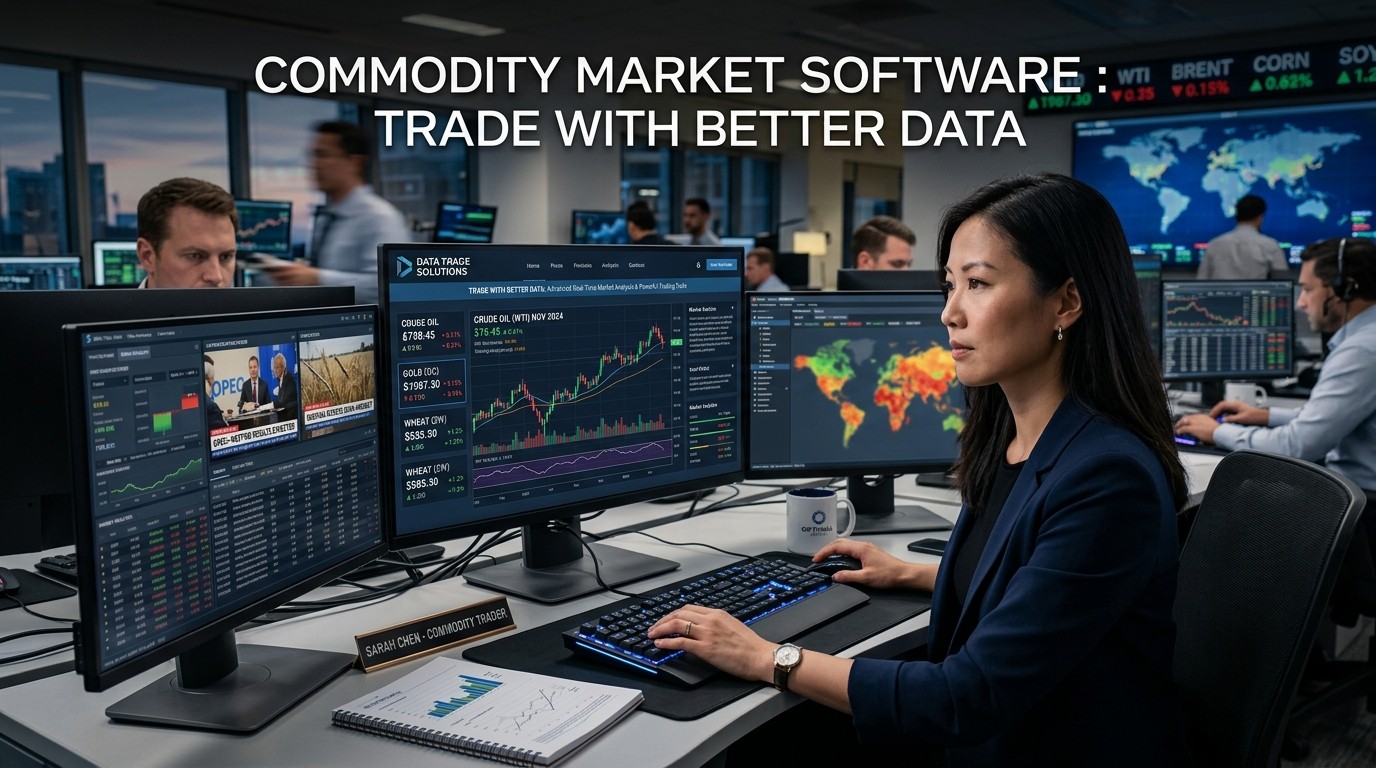
Commodity market software helps traders and businesses use cleaner data, automate workflows, and make faster decisions in volatile markets where timing, accuracy, and risk control matter most.
Commodity trading has always depended on information, but the speed and complexity of today’s markets make data even more important. Prices move quickly, supply chains shift, geopolitical events affect availability, and risk can change in minutes. In that environment, Commodity Market Software becomes a practical advantage because it helps traders organize information, analyze trends, and act faster with more confidence.
The purpose of Commodity Market Software is not only to display numbers. It gives businesses a better way to connect market data, trading activity, risk signals, and operational workflows in one place. That matters because commodity markets are influenced by more than price alone. Weather, logistics, inventory, contracts, credit exposure, and production changes all affect trading outcomes.
For businesses that rely on commodities, better data can mean better decisions. Commodity Market Software helps reduce manual work, improve visibility, and turn fragmented information into something useful. It supports the kind of informed action that is difficult to achieve when teams are stuck between spreadsheets, emails, and delayed reporting.
What It Does
Commodity Market Software is designed to centralize, organize, and analyze information related to commodity trading and market operations. It can support front-office trading, middle-office risk management, and back-office settlement processes. In many organizations, the software becomes the hub that connects market intelligence with business execution.
The strongest systems gather data from multiple sources, including exchange feeds, broker quotes, internal transactions, and historical pricing records. Commodity Market Software then processes that information into dashboards, reports, alerts, and workflows that help teams understand what is happening and what it may mean. This reduces the effort needed to move from raw data to action.
The software is especially useful because commodity markets are rarely simple. A single decision may depend on multiple variables such as delivery dates, contract terms, storage capacity, transportation constraints, and price differentials. Commodity Market Software gives teams a structured way to handle that complexity without losing speed.
Core functions
-
Real-time market data aggregation.
-
Contract and position tracking.
-
Risk monitoring and exposure analysis.
-
Workflow automation for trade-related tasks.
-
Reporting and forecasting support.
Better Data Quality
One of the biggest benefits of Commodity Market Software is better data quality. Trading teams often struggle when important information lives in separate systems or in manually updated spreadsheets. That leads to inconsistency, duplication, and errors. Commodity Market Software helps solve this by consolidating data into a more reliable environment.
Better data quality matters because traders do not make decisions based on market data alone. They also depend on accurate internal records, updated position information, and timely operational details. If those inputs are wrong or delayed, even the strongest strategy can fail. Commodity Market Software improves confidence by reducing the chance of working from outdated numbers.
It also helps create a single version of truth. When the same pricing, exposure, and inventory details are shared across teams, people spend less time debating numbers and more time making decisions. Commodity Market Software improves alignment, which is especially valuable in organizations with multiple departments or trading desks.
A cleaner data foundation also supports better planning. When historical records are accurate, teams can analyze trends with more confidence. Commodity Market Software makes it easier to trust the underlying information before using it for forecasting, hedging, or reporting.
Faster Trading Decisions
In commodity markets, timing can be as important as insight. Prices may move quickly after a news event, production update, or logistics disruption. Commodity Market Software helps teams respond faster because it organizes information in a way that is easier to act on.
Instead of waiting for manual reports or piecing together updates from multiple sources, traders can use live dashboards and alerts. That means they can identify opportunities or risks sooner. Commodity Market Software compresses the time between market movement and business response.
This speed also helps reduce emotional decision-making. When people are under pressure and information is incomplete, they may react too quickly or too slowly. Commodity Market Software gives them a clearer view of the situation, which supports more rational decisions.
Faster decision-making is especially important in high-volume environments. When teams are managing multiple contracts, delivery schedules, or pricing structures, even a small delay can create larger downstream effects. Commodity Market Software helps keep the process moving.
Risk Management Advantages
Risk is a constant part of commodity trading. Prices move, supply shifts, counterparties change, and exposure can grow unexpectedly. Commodity Market Software helps organizations monitor and manage those risks with more structure and less guesswork.
A strong platform can show open positions, exposure levels, margin implications, and scenario impacts in near real time. That visibility matters because risk cannot be managed effectively if it is hidden in fragmented systems. Commodity Market Software gives teams a more complete view of what they are carrying.
It also supports more proactive action. If the software identifies threshold breaches or unusual market movement, teams can react before problems escalate. Commodity Market Software turns risk management into an ongoing process instead of a monthly review exercise.
This is where psychological confidence matters too. Trading teams work better when they know the organization has visibility into exposure and limits. Commodity Market Software creates that confidence by making risk more measurable and easier to discuss across the business.
Risk controls
-
Exposure monitoring.
-
Margin and P&L visibility.
-
Scenario analysis.
-
Alerts for threshold breaches.
-
Historical trend analysis.
Workflow Automation
Commodity trading is not just about price discovery. It also involves a lot of repetitive tasks such as capturing quotes, updating records, sending approvals, and reconciling documentation. Commodity Market Software helps automate many of these processes, which reduces manual effort and lowers the chance of human error.
Automation matters because trading operations are time-sensitive. When people spend too much time on routine tasks, they have less time for analysis and strategy. Commodity Market Software removes friction from the process so teams can focus on higher-value work.
This automation can extend into related business areas as well. For example, many teams compare the operational efficiency benefits of Commodity Market Software with systems like Sales Order Automation Software when they are trying to streamline execution across the organization. The shared goal is to reduce delay and improve accuracy through structured workflows.
Automation also helps standardize procedures. Instead of relying on each person to remember a different step, the software ensures the process follows the same logic every time. Commodity Market Software improves repeatability, which is a major advantage in high-pressure trading environments.
Market Intelligence
Good trading depends on more than internal records. Commodity Market Software often includes market intelligence features that help teams interpret external data such as prices, fundamentals, news, and trends. This broadens the decision-making picture and reduces blind spots.
Market intelligence is useful because commodities are influenced by global conditions. Weather changes, transportation bottlenecks, policy shifts, and supply disruptions can all affect price direction. Commodity Market Software helps teams connect those signals to their own positions and business goals.
When intelligence is presented clearly, it is easier for traders to move from observation to action. That is one of the reasons why usable design matters so much. A cluttered interface can hide insight, while a clean platform can make patterns obvious. Commodity Market Software should help the user understand the market, not overwhelm them.
In many ways, this mirrors the value of Automated Software Testing Services in software teams: both aim to detect issues earlier and make operations more reliable. In trading, catching a signal early can be financially meaningful. Commodity Market Software supports that early-warning mindset.
Forecasting and Planning
Forecasting is a major reason businesses invest in Commodity Market Software. Future price direction, supply availability, and demand shifts all influence strategy. While no system can predict the market perfectly, better forecasting tools can improve the quality of decisions.
A useful platform combines historical data with current conditions so teams can evaluate likely outcomes. Commodity Market Software may help users compare trends, test assumptions, and review scenario-based projections. That gives decision-makers a more informed basis for planning.
This is especially important in businesses with physical exposure. Companies that buy, sell, store, transport, or process commodities need to think beyond price alone. Commodity Market Software helps align pricing insights with logistics, inventory, and operational constraints.
Planning also becomes easier when data is connected across departments. Supply chain teams, trading teams, and finance teams can work from the same information instead of separate files. Commodity Market Software therefore supports a more coherent business strategy.
Operational Visibility
Commodity operations involve multiple moving parts. That includes trades, shipments, orders, inventory, settlements, and reporting. Commodity Market Software improves visibility across these areas so teams can see what is happening without chasing updates from different systems.
Visibility matters because lack of clarity creates delay. If nobody knows the current status of a trade or shipment, decisions slow down and risk increases. Commodity Market Software creates a more transparent environment where status information is easier to access and act on.
That transparency helps managers too. Leaders can identify bottlenecks, monitor performance, and review activity without relying entirely on manual updates. Commodity Market Software gives them a stronger operational picture, which supports better oversight and planning.
This kind of visibility becomes even more powerful when connected to broader business systems. For example, organizations using Supply Chain Automation Software often want the commodity side to sync with logistics and inventory flows. Commodity Market Software can support that connection and make operations feel less fragmented.
Key Business Benefits
Human Psychology in Trading
Commodity trading is often thought of as numbers and models, but psychology plays a major role. When people feel uncertain, they hesitate. When they feel overwhelmed, they make poor choices. Commodity Market Software helps reduce that mental strain by bringing structure to complexity.
A clean, reliable system can lower cognitive load. Instead of remembering dozens of spreadsheets or interpreting incomplete updates, users can focus on the signals that matter. Commodity Market Software supports clarity, and clarity reduces stress.
Confidence also matters in group decision-making. When traders, analysts, and managers can all see the same data, conversations become more productive. Commodity Market Software improves shared understanding, which can reduce internal friction and speed up decision cycles.
That matters because humans tend to trust what they can see and verify. Commodity Market Software increases that sense of visibility, which can improve both individual judgment and team coordination. In volatile markets, that confidence is a practical advantage.
Real-World Use Cases
Commodity Market Software is useful in many sectors, including energy, agriculture, metals, manufacturing, logistics, and procurement. Each of these industries deals with commodity-related pricing, inventory, contracts, or supply decisions. The software helps them manage those responsibilities with more precision.
A commodity trader may use the software to monitor prices, manage positions, and evaluate risk exposure. A procurement team may use it to track buying decisions and forecast sourcing costs. A risk manager may use it to analyze scenario impacts and identify limit breaches. Commodity Market Software supports all of these roles in different ways.
It is also useful for companies that need better document and communication flows around trade activity. Teams often compare the coordination benefits of Commodity Market Software with tools like Digital Mailroom Automation Software because both help route important information faster and with fewer mistakes.
In a more integrated operation, the software can also support settlements, contract review, and reporting. That makes it a foundation for better decision-making across the commercial stack. Commodity Market Software is not only for traders; it is for any business that depends on commodity data to move efficiently.
Choosing the Right System
Not all platforms offer the same depth or flexibility. The right Commodity Market Software depends on the size of the business, the asset classes involved, and the complexity of the workflow. A small team may need simplicity, while a large enterprise may require advanced integrations and detailed risk analytics.
A good evaluation starts with data coverage. The software should provide the sources and refresh rates the business actually needs. Commodity Market Software should also fit into existing processes instead of forcing a complete operational redesign. Integration with ERP, accounting, and reporting systems is often essential.
Usability is another factor. If the interface is too difficult, adoption will suffer. Commodity Market Software should make it easy for users to find data, understand alerts, and perform common tasks without unnecessary friction. Good design often determines whether a system becomes valuable or abandoned.
Support and scalability matter too. As the business grows, the platform should be able to handle more users, more data, and more complexity. A solid implementation plan helps ensure Commodity Market Software delivers value not just on day one but over time.
Strategy and Business Value
The real value of Commodity Market Software is not only operational. It also contributes to strategy. When leaders have better access to data, they can make more informed choices about purchasing, pricing, hedging, storage, and supply planning. That can have a direct effect on margin and resilience.
Better data also supports better timing. In commodity markets, timing can influence cost, availability, and competitive position. Commodity Market Software gives businesses the tools to act with more speed and less uncertainty. That improves strategic flexibility.
The software also helps organizations build repeatable processes. Instead of relying on a few key people to understand the market, the business can create a shared decision framework. Commodity Market Software makes knowledge more visible and less dependent on individual memory.
For leadership teams, that creates confidence in scaling. When processes are measurable and decisions are supported by data, growth becomes easier to manage. Commodity Market Software helps turn trading from a reactive activity into a more disciplined business function.
Conclusion
Commodity Market Software helps businesses trade with better data by improving visibility, speed, accuracy, and control across the trading process. It supports market analysis, risk management, workflow automation, and forecasting while reducing the friction that often slows commodity operations down. For companies dealing with volatile markets and complex data, that combination is powerful.
The strongest benefit is that it helps people make better decisions under pressure. When data is organized, timely, and reliable, teams can react with more confidence and less guesswork. Commodity Market Software is therefore not just a technology upgrade. It is a practical business tool that helps organizations operate smarter in one of the most demanding environments in commerce.
Frequently Asked Questions (FAQ)
1. What is Commodity Market Software?
Commodity Market Software is a platform that helps businesses manage pricing data, trading activity, risk, forecasting, and related workflows.
2. Who uses Commodity Market Software?
Traders, analysts, procurement teams, risk managers, and operations teams all use it in different ways.
3. Why is data quality important?
Because trading decisions are only as good as the data behind them. Clean data reduces errors and improves confidence.
4. Can it help with risk management?
Yes. It helps monitor exposure, track positions, and identify market changes sooner.
5. Is it useful for non-trading teams?
Yes. Supply chain, finance, procurement, and operations teams also benefit from better commodity visibility.
6. Does it automate workflows?
Many systems do. They can route tasks, generate alerts, and reduce manual administrative work.
7. How does it improve decision-making?
It brings together real-time and historical data so users can act on clearer information.
8. Can it work with other business systems?
Yes, many platforms integrate with ERP, accounting, reporting, and operational tools.
9. Is it only for large enterprises?
No. Smaller businesses can also benefit if they need better commodity data and workflow control.
10. Why does it matter in volatile markets?
Because fast-moving markets reward speed, structure, and accurate information. Commodity Market Software helps deliver all three.



Leave a Reply