


Generative AI is revolutionizing software testing by automating test creation, improving coverage, generating synthetic data, and enabling faster, smarter QA processes while reducing costs and enhancing overall software quality.
In today’s digital landscape, the demand for rapid software delivery is higher than ever. Development teams are under pressure to accelerate release cycles while ensuring that each build meets rigorous quality standards. Enter generative AI for automated software testing, a cutting-edge approach that empowers organizations to generate test cases, synthetic data, and diagnostics at scale. This year, teams worldwide are adopting these intelligent systems to drive efficiency, minimize human error, and uncover edge-case vulnerabilities long before they reach production.
Generative AI models leverage vast repositories of code, historical defect logs, and user behavior patterns to produce novel test scripts tailored to any application. Unlike traditional rule-based frameworks, these adaptive engines learn continuously—refining their outputs based on live feedback and newly discovered code paths. As a result, companies can shift from labor-intensive test creation to strategic oversight, allowing QA engineers to focus on exploratory testing, performance tuning, and business-critical validation.
In this article, we will explore how generative AI for automated software testing is transforming QA workflows. We’ll break down the underlying mechanisms, highlight the core advantages, examine real-world use cases, share best practices for integration, and outline the challenges to watch for. Along the way, we’ll reference authoritative sources such as the National Institute of Standards and Technology and insights from the Stanford AI Lab to ground our discussion in research-backed guidelines. Whether you’re a development lead, QA manager, or DevOps engineer, you’ll gain actionable knowledge to harness the power of generative AI and elevate your automated testing strategy.
Understanding Generative AI in the Testing Context
Generative AI represents a class of machine learning techniques designed to create new content—be it images, text, or code by learning statistical patterns from existing data. When applied to software testing, this technology digests source code, user stories, design documents, and historical bug reports to generate comprehensive test suites. By interpreting the intent behind functions and UI flows, modern models can anticipate edge cases that might elude conventional scripted frameworks.
At the core of generative AI for automated software testing are transformer-based architectures, similar to those that power advanced language models. These systems are trained on large corpora of code repositories and labeled test outcomes. During training, they learn to map code constructs to appropriate validation steps whether unit tests, UI automation scripts, or security probes. As testing artifacts accumulate, the models adapt, fine-tuning their output for increased accuracy and reduced false positives.
Today, teams can integrate dedicated AI engines such as OpenAI Codex or custom transformer models into their CI/CD pipelines. These engines analyze commit diffs in real time, generating or updating tests whenever a pull request is created. Some platforms even embed rules to detect deprecated patterns or compliance violations ensuring that every merge meets audit requirements.
Importantly, generative AI tools provide transparency through explainable AI features. Test engineers receive annotations detailing why a specific test case was generated, referencing code segments and historical bug examples. This visibility fosters trust in the system and accelerates review cycles. As a result, organizations can adopt an AI-augmented approach where the machine proposes tests and humans verify critical scenarios striking a balance between automation and human expertise.
Key Benefits of Generative AI–Powered Testing
Adopting generative AI for automated software testing yields several compelling advantages that combine speed with depth. First and foremost, enhanced test coverage emerges as a major win. By systematically exploring code paths and potential user behaviors, AI engines fill gaps that manual test designers might overlook. Studies show that AI-augmented testing can increase defect detection by up to 30% in complex applications.
Faster test creation is another significant benefit. What once took QA teams days or weeks to script can now be accomplished in hours. Engineers feed the AI model with feature specifications or user stories, and within minutes, a suite of unit tests, integration checks, and end-to-end scenarios is generated. This rapid turnaround accelerates feedback loops, enabling developers to identify regressions earlier in the development cycle.
Intelligent test data generation further streamlines the process. Generative AI produces realistic datasets masking sensitive information to remain compliant with regulations like GDPR and HIPAA. Instead of relying on static data snapshots or manually curated CSV files, teams leverage AI-driven synthetic data that reflect real-world distributions, edge-case values, and boundary conditions.
Continuous learning is built into many AI testing platforms. Each test execution, pass/fail result, and defect logged is fed back into the model, refining its parameters. Over time, the system becomes more adept at predicting common failure modes and prioritizing high-risk scenarios. This adaptive cycle reduces false positives and ensures that resource-intensive tests focus on areas of greatest impact.
Finally, cost efficiency stems from reduced manual labor and maintenance. Traditional test suites often degrade as applications evolve, requiring constant script updates. By contrast, generative AI automatically adjusts tests when code changes, trimming obsolete steps and generating new checks for added features. This hands-off maintenance approach translates to lower operational costs and frees up QA staff to engage in creativity-driven activities such as exploratory testing and performance tuning.
Common Use Cases in Diverse Industries
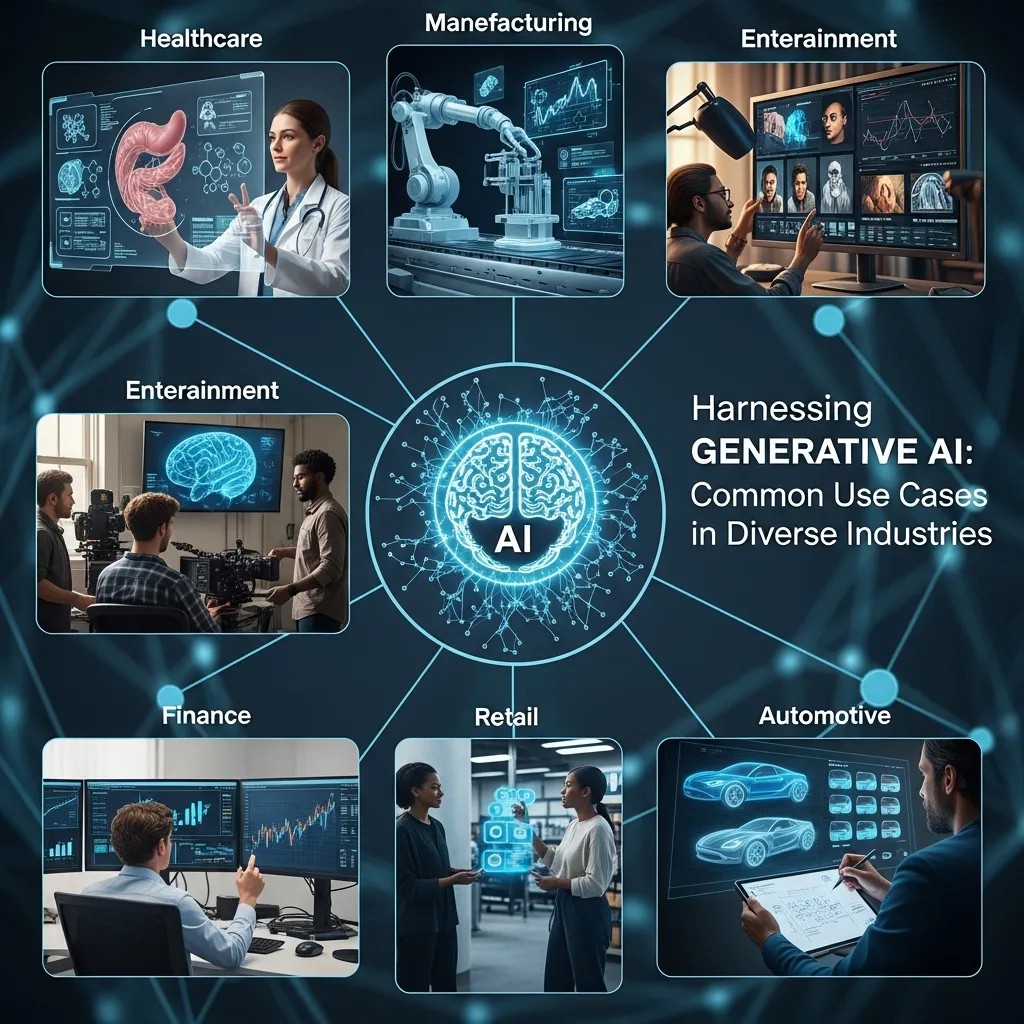
Generative AI for automated software testing is not limited to a single domain it has proven value across fintech, e-commerce, healthcare, and beyond. In financial services, for example, AI-driven unit test generation ensures that complex transaction logic and edge-case rounding scenarios are verified automatically. A leading global payments firm implemented AI-synthesized test suites and reduced its regression cycle by more than 60%.
In the e-commerce sector, retailers leverage generative AI to build performance and load tests that mirror peak shopping patterns. By analyzing historical traffic spikes, AI crafts load profiles to stress servers and reveal scaling bottlenecks. One prominent online marketplace avoided catastrophic outages during holiday sales peaks by employing these AI-designed scenarios.
Healthcare software developers face stringent privacy regulations when testing applications that handle patient records. Generative AI enables the creation of fully synthetic datasets that preserve realistic patient demographics and medical histories without exposing actual PHI. Academic institutions such as NIH endorse synthetic data methodologies for compliant testing in clinical research environments.
Security testing also benefits from AI-powered automation. By learning from known vulnerabilities and penetration test results, generative models produce targeted attack vectors and payloads. Penetration testers can then validate whether the application resists SQL injection, XSS exploits, and other threats—often discovering zero-day risks that conventional scanners miss.
Even embedded systems and IoT devices are in the AI testing revolution. Engineers deploy micro-test scripts directly to edge hardware to validate sensor interactions, firmware updates, and communication protocols. As a result, device manufacturers achieve higher reliability in field deployments and faster time-to-market.
Integrating Generative AI into Your Testing Pipeline
To adopt generative AI for automated software testing effectively, a structured integration plan is essential. Start by selecting an AI platform tailored to code comprehension whether it’s an off-the-shelf solution like GitHub Copilot for testing or a custom transformer model trained on proprietary codebases. Evaluate factors such as language support, model size, and cloud vs. on-premises deployment.
Next, define quality gates within your CI/CD pipeline. Establish clear pass/fail criteria for AI-generated tests, ensuring that only validated scripts are merged. Integrate these gates into pull request checks so that developers receive immediate feedback on coverage gaps, failing scenarios, and security flags.
Human oversight remains crucial. While generative AI can propose tests, QA engineers should review and refine critical cases especially those involving complex business logic or compliance requirements. Implement a review workflow where AI outputs are annotated, discussed, and approved before full-scale execution.
Data privacy compliance must be a priority. Sanitize both the training inputs and the synthetic datasets generated to maintain adherence to GDPR, HIPAA, and other relevant standards. Maintain an audit trail of data usage and model retraining to demonstrate due diligence during regulatory assessments.
Finally, establish feedback loops to close the performance optimization cycle. Capture test results, false positive rates, and developer comments to retrain the model periodically. By monitoring metrics such as defect detection rate, test flakiness, and execution duration, teams can guide model improvements and ensure that AI outputs remain aligned with evolving codebases and business priorities.
Best Practices for Effective AI-Driven Testing
Implementing generative AI for automated software testing demands a balanced approach that combines automation with strategic oversight. Begin with a modular prompt engineering strategy: create reusable prompt templates that cater to different application layers API, UI, database and update them as features evolve.
Maintain version control for AI artifacts. Treat test models, prompt definitions, and generated scripts as code. Store them in a Git repository to track changes, roll back to previous iterations, and conduct code reviews on AI artifacts just like any other source files.
Adopt a scalable infrastructure to handle resource-intensive model training and execution. Containerize AI components and leverage cloud GPUs or managed AI services to ensure elastic capacity. This approach prevents bottlenecks and allows teams to scale tests on demand during peak development cycles.
Combine AI-driven automated tests with manual exploratory sessions. While generative AI excels at exhaustive coverage and regression checks, human testers shine at context-driven validation and UX feedback. A hybrid strategy maximizes ROI by allocating AI to repetitive tasks and humans to creative exploration.
Continuously monitor AI test effectiveness metrics. Dashboard key performance indicators—such as average time to generate tests, defect discovery rate, and maintenance effort saved—to quantify the impact of generative AI on quality and speed. Use these insights to refine your automation roadmap and prioritize further investments in AI-driven testing.
The Rise of Harnessing Generative AI in Software Testing
In today’s rapidly evolving digital ecosystem, software development cycles have become shorter, more complex, and highly competitive. Organizations are expected to release high-quality applications at speed while maintaining stability and security. This pressure has led to the rise of Harnessing Generative AI as a transformative approach in automated software testing.
Unlike traditional automation frameworks that rely on predefined scripts, generative AI introduces intelligence into the testing lifecycle. It can analyze codebases, interpret user behavior, and generate dynamic test cases in real time. This shift allows teams to move from manual-heavy QA processes toward intelligent, self-improving testing systems.
At the same time, modern engineering practices such as Technical Debt Management are becoming increasingly important. Poorly tested or rushed code can create long-term maintenance issues, and generative AI helps reduce this burden by ensuring continuous test coverage and early defect detection. As a result, organizations can achieve both speed and sustainability in software delivery.
Evolution of AI-Driven Testing Systems
The evolution of testing methodologies has moved from manual testing to automation, and now to AI-driven intelligence. Early automated testing tools required strict scripting and maintenance, which limited flexibility. However, Harnessing Generative AI has changed this paradigm completely.
Modern AI models, particularly transformer-based architectures, can learn patterns from code repositories, bug histories, and test logs. These models generate meaningful test cases without explicit instructions. Over time, they refine themselves based on execution results and developer feedback.
This evolution represents a major shift in quality assurance. Instead of simply verifying expected outcomes, AI systems now predict unexpected behaviors. They anticipate edge cases, identify potential failure points, and create tests that human engineers might overlook.
Core Architecture of Generative AI Testing Systems
A generative AI testing system typically consists of several interconnected layers:
- Code Analysis Engine
- Model Training Layer
- Test Generation Module
- Execution Pipeline Integration
- Feedback Loop System
The code analysis engine scans repositories and extracts structural and semantic information. The model training layer processes this data to learn patterns and relationships. The test generation module then creates unit, integration, and system-level tests.
The execution pipeline integrates with CI/CD workflows, ensuring tests run automatically during development cycles. Finally, the feedback loop continuously improves the system by learning from test results.
When organizations adopt Harnessing Generative AI, they essentially transform their QA infrastructure into a self-adaptive ecosystem capable of evolving alongside the application itself.
Key Capabilities of Generative AI in Testing

One of the strongest advantages of generative AI is its ability to deliver multiple capabilities simultaneously:
Intelligent Test Generation
AI creates test cases based on code structure and expected functionality.
Synthetic Data Creation
It generates realistic datasets without exposing sensitive user information.
Predictive Bug Detection
AI identifies high-risk areas in the code before execution.
Self-Healing Tests
When application UI or logic changes, AI updates test scripts automatically.
Cross-Platform Testing
Generative models can adapt tests across web, mobile, and API layers.
These capabilities significantly reduce manual effort and improve reliability. In fact, many organizations report improved stability when combining AI testing with structured Technical Debt Management practices.
Real-World Applications Across Industries
The adoption of generative AI testing spans across multiple industries:
Banking & Fintech
AI validates transaction workflows, fraud detection systems, and compliance rules.
Healthcare
Synthetic patient data is used to test medical systems without violating privacy regulations.
E-commerce
AI simulates user journeys during peak traffic events like flash sales.
SaaS Platforms
Continuous integration pipelines benefit from real-time test generation.
IoT & Embedded Systems
AI ensures firmware stability and sensor accuracy across devices.
In all these sectors, Harnessing Generative AI enables organizations to reduce testing cycles while increasing coverage and accuracy.
Integration into Modern DevOps Pipelines
Successful implementation requires deep integration with CI/CD systems. Generative AI tools must connect seamlessly with platforms like Jenkins, GitHub Actions, and GitLab CI.
During pull requests, AI analyzes code diffs and generates relevant test cases. These tests are automatically executed in staging environments before merging. This ensures early detection of issues and prevents faulty code from reaching production.
Additionally, AI systems can prioritize tests based on risk levels, focusing resources on critical modules. This risk-based testing approach aligns well with modern DevOps strategies and improves efficiency.
Organizations that integrate Harnessing Generative AI into DevOps pipelines often experience faster release cycles and reduced rollback incidents.
Enhancing Software Quality and Reducing Bugs
One of the most impactful benefits of generative AI is improved software quality. By continuously analyzing historical defects and runtime behavior, AI systems identify patterns that lead to failures.
Instead of relying solely on predefined test scenarios, AI explores hidden execution paths. This results in higher defect detection rates and improved system reliability.
Moreover, AI reduces regression issues by ensuring that every new code change is automatically tested against existing functionality. This significantly enhances long-term system stability and supports effective Technical Debt Management by preventing accumulation of unresolved defects.
Challenges and Limitations of Generative AI Testing
Despite its advantages, generative AI is not without challenges:
High Initial Setup Cost
Training domain-specific models requires infrastructure and data.
False Positives
AI may sometimes generate irrelevant or redundant test cases.
Lack of Explainability
Complex models can be difficult to interpret.
Data Privacy Concerns
Sensitive data must be carefully handled during training.
Dependency on Quality Codebase
Poor-quality input data can reduce model effectiveness.
To overcome these challenges, organizations must implement strong governance frameworks and maintain human oversight in critical testing decisions.
Best Practices for Implementation
To maximize the benefits of Harnessing Generative AI, organizations should follow these best practices:
- Start with hybrid testing models combining AI and manual QA
- Maintain version control for AI-generated test scripts
- Use modular prompt engineering for consistent outputs
- Integrate AI tools into CI/CD pipelines gradually
- Monitor test accuracy and refine models regularly
- Ensure compliance with security and privacy regulations
These practices ensure that AI enhances rather than replaces human expertise. They also help maintain system stability and reduce long-term maintenance costs.
Future of Generative AI in Software Testing

The future of software testing is deeply intertwined with artificial intelligence. As models become more advanced, they will not only generate tests but also predict system failures before they occur.
We will see AI-driven autonomous testing frameworks capable of self-correction, self-optimization, and self-learning. Combined with cloud-native infrastructure, testing will become fully dynamic and adaptive.
In this future landscape, Harnessing Generative AI will be essential for maintaining competitive advantage. It will redefine how QA teams operate, shifting their focus from execution to strategic quality engineering.
When combined with disciplined engineering practices and effective Technical Debt Management, generative AI will become a cornerstone of resilient, scalable, and intelligent software systems.
Frequently asked questions (FAQ)
What is generative AI for automated software testing?
Generative AI for automated testing uses machine learning models trained on code, bug reports, and user patterns to generate comprehensive test cases, synthetic data, and diagnostics without manual scripting.
How do I integrate generative AI into my existing CI/CD pipeline?
Select an AI testing platform or train a custom model, then configure it to analyze commit diffs and generate or update tests during pull requests. Define quality gates and automate pass/fail checks to enforce standards.
How is data privacy maintained when using AI-driven test data?
AI-driven test data is typically synthetic, masking or replacing sensitive information. Ensure compliance by sanitizing inputs, tracking data lineage, and adhering to GDPR, HIPAA, or other relevant regulations.
What are common challenges when adopting AI-driven testing?
Challenges include initial model training costs, managing false positives, ensuring human oversight for critical logic, and maintaining auditability of AI artifacts and data usage.
In today’s fast-paced software industry, generative AI for automated software testing has emerged as a transformative enabler. By synthesizing test cases, generating realistic data, and learning continuously from outcomes, these systems empower teams to achieve faster release cycles without compromising on quality. Organizations that embrace this paradigm shift reap benefits such as enhanced coverage, accelerated feedback loops, cost savings, and greater resilience against vulnerabilities.
To succeed with generative AI testing, companies must adopt a thoughtful integration strategy one that balances automation with human oversight, enforces data privacy standards, and embeds continuous learning mechanisms. As we navigate the complexity of modern applications, combining AI’s scalability with human ingenuity will define the next frontier in reliable, scalable software delivery. The time to act is now: start experimenting with generative AI tools today and position your QA practice at the forefront of innovation.



Leave a Reply